
Volvo and Volkswagen are both European brands, they have both made semi-premium cars and SUV’s since the 2000’s, and they even both begin with a V. For a long time, it could be argued that, during the 2000s, Volkswagen managed to step up to the level of Volvo, or on the flip side Volvo managed to slip down to the level of Volkswagen. In this article we will see if Volvo and Volkswagen are the same in the modern age and compare the two brands from the 2000s to now, to see where they have deviated from each other since, and go through some of the critical models from both brands.
Volkswagen’s Introduction To The US
One Of Numerous German Exports

The Volkswagen Group of America was founded in 1955, coming to the US shores with the eternal VW Beetle and VW T2 Bus. The initial launch went well, reaching 569,696 cars sold in 1970. The Golf and Jetta would bring the brand into the 80s and 90s, but with mounting pressure from Japanese rivals, sales dropped in 1993 to a record low, with fewer than 50,000 cars sold. Since then, Volkswagen has gone back and forth, bouncing back and then losing its way again, as we will get into later in this article. Obviously, Diesel Gate played a huge role in this, basically kneecapping any hope of being a top player in the US market for decades to come.
This has been a trend for the Volkswagen brand. With it being such a powerhouse in Europe, it is surprising to see that it has never quite been able to capture the US market similar to other mainstream brands like Ford, Toyota, or Kia. It is almost like it takes one step forward for every two steps back in its recent car designs and decisions. While sub-brands Audi, Bentley, and Lamborghini go from strength to strength, VW in recent years seems to lag behind with mixed reviews and poor reliability.
Volvo’s Arrival Stateside
A Different Flavor Of European

In August 1955, Volvo entered the US market with the PV 444 and would quickly become the benchmark for safety and rock-solid build quality. It would peak with the Volvo 240, beginning in 1974 and ending in 1993. Just like VW, Volvo’s fortunes would ebb and flow throughout the 70s, 80s and 90s, with the company not quite managing to cement itself as a luxury brand, but neither a mainstream one due to its pricing. Ford would buy out Volvo in 1999, attempting to turn it into a more profitable brand at the expense of brand image, something the Swedish automaker wouldn’t regain until the 2010s.
Nowadays, it’s not really possible to compare Volvo to Volkswagen, but there was a time when both brands were on equal footing. How did this happen, and how did Volvo pull itself back up to the level of Audi and Mercedes-Benz?
Almost Luxury: When Volkswagen Rose…
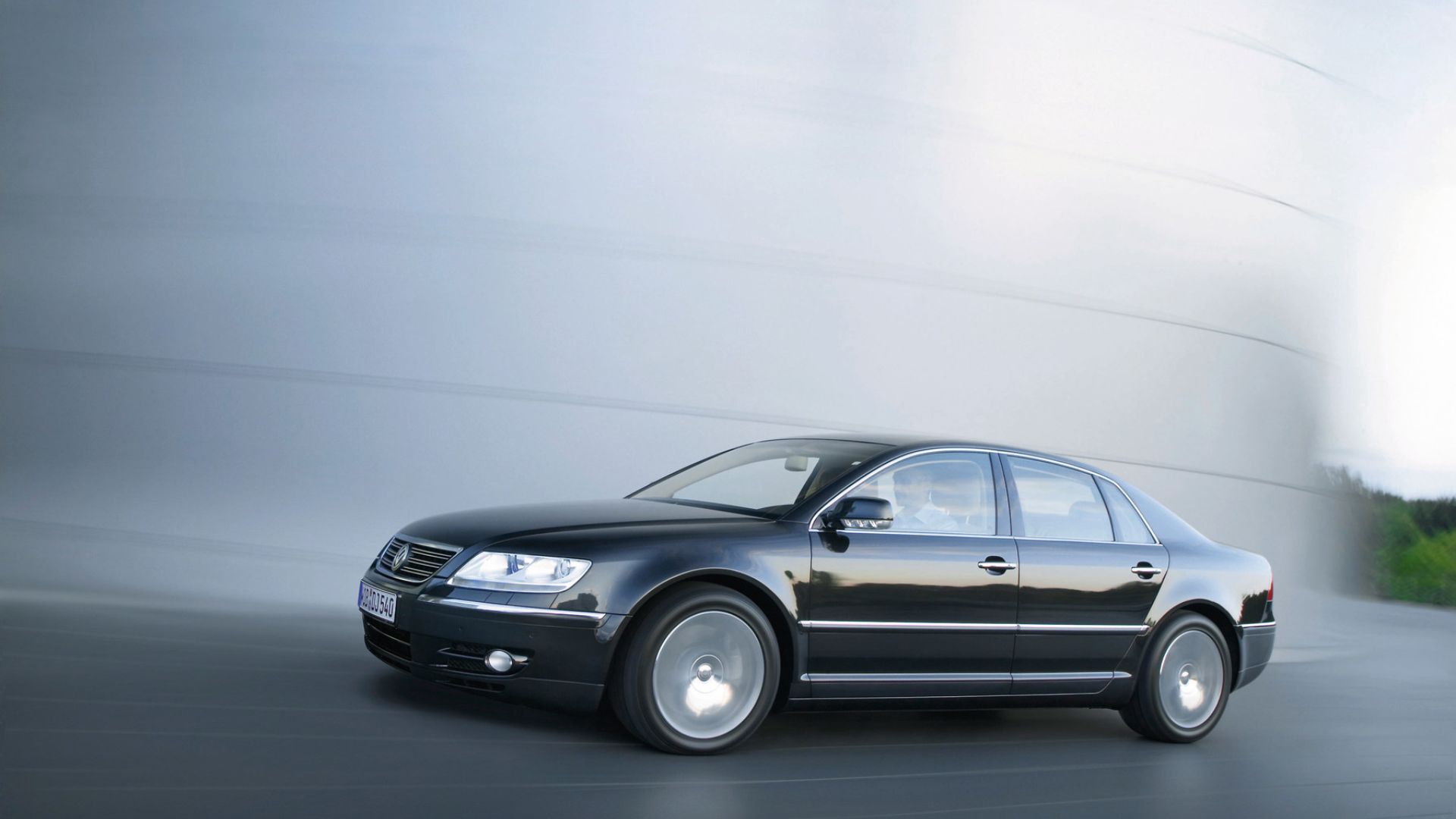
The 2000s were a crazy time for the auto industry with huge advancements in technology and power. One of the biggest players in this space was the Volkswagen/Audi Group. The Bugatti Veyron, the revitalization of Bentley and Lamborghini, and the push to make Audi a force in the German luxury space created a vast number of fast, luxurious and downright insane models that could not be replicated today. Spearheaded by Ferdinand Piëch, Volkswagen would itself go through a model renaissance. This was done to counter the more premium luxury brands moving downmarket in Europe, with models like the BMW 1 Series and 3 Series compact, and Mercedes A-Class and CLC being seen as a threat to the more modest cars Volkswagen produced at the time. VW would go on the counterattack, attempting to push up the market with some seriously expensive and luxurious models.
The Volkswagen Phaeton

The Volkswagen Phaeton would be a huge loss-leader for VW, costing the company millions, flopping commercially and never seeing a second generation. For all its negatives, it did do one thing right: it cemented Volkswagen as a serious force in the luxury game during this era. From a 3.0 VR6 all the way up to a 6.0 W12, the Phaeton was set to take back sales that more premium marks were stealing from the Golf and Jetta, targeting the S-Class and 7 Series. It shared its platform with the Audi A8 and Bentley Continental, and was the official state car of Germany from 2002 to 2005. While it didn’t sell well, the Phaeton stood as a high watermark for Volkswagen, with it being one of the most powerful, expensive and luxurious cars the brand has ever made.

The Volkswagen Touareg
A more successful model in the push against BMW and Mercecdes-Benz was the Volkswagen Touareg. It would launch in 2002, and competed with other early off-road rivals like the BMW X5, Range Rover Sport, and Porsche Cayenne. It did well against them, winning Car and Driver magazine’s Best Luxury SUV for 2003, and Motor Trend’s Sport/Utility of the Year for 2004. With a trick four-wheel-drive system, air suspension and acres of wood and leather, the Touareg would be a decent seller for VW worldwide, spawning a second and European-exclusive third generation. The subsequent generations would continue to be a capable and luxurious offering at a good price from a less stuffy brand, in a similar spirit to the Toyota Land Cruiser. It was recently announced that the Touareg will be discontinued after the current generation, since it no longer fits into the Volkswagen product lineup in Europe.
The B6 Volkswagen Passat

The B6 Passat was launched in 2006 and would take a rather premium approach to the mainstream midsize sedan. Again, VW would aim its sights slightly more upmarket, trying to draw buyers away from the C-Class or 3 Series. The difference in interior quality was where this became most evident, with soft-touch materials and a luxurious, damped feeling to the buttons and switch gear. The mainstream rivals to this at the time were models such as the Chevrolet Impala, Toyota Camry and Honda Accord on the low end, and the Saab 9-3, Mercury Sable, and even the Volvo S40 on the higher end. It even spawned an even more up-market sub-model with the Passat CC pushing even closer to the German big three.
By the end of the 2000s, Volkswagen’s dreams of becoming a premium brand were failing, as the next generation was split, with the US and Chinese markets getting less impressive versions of what was sold in Europe. This Passat was considered a let-down with its much less extensive content compared to rivals. The US Passat would be discontinued in 2022, but it still sells in Europe to this day.
…And Volvo Dipped

Volvo, during the 2000s began to fall behind its German rivals, instead being seen as a rival to semi-luxury or American premium brands like Acura, Buick, or even Volkswagen. The acquisition by Ford meant that, just like Jaguar, Volvo would move to create more sales by focusing on more affordable segments of the market. It took until the 2010s for Volvo to get back up to its Audi and BMW-fighting heights. With all this said, there was one full-fledged luxury model that Volvo brought out at that time that was a huge success.
The Volvo XC90

The Volvo XC90 was the light in the dark for Volvo. With models like the S70 and original S90 still fresh in peoples’ minds, the XC90 was launched as one of the newest and freshest designs of its time. It was available with a range of funky five-cylinder engines all over the world, and could even be optioned with a Yamaha-tuned V8. It would go against the Volkswagen Touareg, Land Rover LR3 and BMW X5, offering a less off-road-centric, but family-focused design with its seven seats.
One thing that did plague the XC90 was, ironically, its longevity. Volvo kept selling the first generation all the way until 2016 in some markets, selling 28,752 units globally in 2014. As a reference, the updated BMW X5 would sell 47,031 units in the US alone that year.
The Volvo C30

While it was loved by enthusiasts, the C30 would be a commercial flop in the US, barely selling 22,233 units over its seven-year life in the local market. It was a quirky hatchback with a five-cylinder engine, a three-door configuration and even a performance version with some extra attention from Polestar. It was more in line with the Volkswagen Golf/Rabbit and Mini Cooper than any of the luxury brands, with the Audi A3 being bigger, more practical and more up-market.
The Volvo S40 (Second Generation)

As previously mentioned, the Volvo S40 was similarly priced to the Volkswagen Passat of the same era. Built during the Ford era of Volvo, it shared parts with the Mazda 3 and European Ford Focus of the time. It would fight with the Acura TSX, VW Passat and other premium compact sedans, and was generally agreed to be quirky, if boring to drive. Again, Volvo’s lack of new generations would rear its ugly head with the S40 hanging on until 2012. That means, for a year, it had to compete with the F30 BMW 3 Series. Again, it was not a bad car, but it was Volvo going down market to try to get more sales at the expense of brand image.
So what changed from the 2000s to now and where did these brands end up?
The Splitting Of Paths: VW vs. Volvo
During the 2010s, both Volkswagen and Volvo experienced huge changes to their model lineups and brand positions and images, and are now considered very different brands, competing in very different segments.
Volkswagen’s Return To The Mainstream
Diesel Gate, along with Ferdinand Piëch stepping down in 2015, marked the end of the luxury Volkswagen experiment. The brand would have to rebuild its image and begin to focus on its core models like the Golf and the Tiguan, while leaving more expensive projects to Audi and Porsche. The launch of Volkswagen’s I.D range of electric cars would come out to middling reviews, with infotainment issues and quality problems. Even the Golf GTI and R would be scrutinized, with the eighth generation being agreed to be worse than its predecessor.
Currently, Volkswagen’s main products are the Atlas, Tiguan and Taos SUVs, with the regular Golf and Passat completely removed from the lineup.
Volvo’s Return To Form

2010 would be a pivotal year for Volvo and a change in its fortunes. Ford would sell the brand to Geely, beginning a new era with new design language. This Geely-owned Volvo would launch an onslaught of new products between 2013 and 2017, with the new flagship being the updated second-generation XC90. This would be a huge success and re-cement the XC90 as one of the most competitive midsize SUVs in the segment. It is the rest of the lineup that would get the biggest boost, with the revamped compact S60 and midsize S90 sedans bringing back comparisons to BMW and Mercedes-Benz. Lastly, the XC60 compact SUV, which launched under Ford management back in 2008, would be redesigned in 2017 to become one of the brand’s biggest successes, peaking in 2021 with 41,582 units sold and comparisons to the Lexus RX and BMW X3 being the norm.
The Future For Volvo And Volkswagen

Both Volkswagen and Volvo have been leaning into the electric vehicle market heavily, with varying levels of success. Volkswagen has found mixed success with its ID range of electric vehicles. After some initial issues with the ID.3 and ID.4, the ID.Buzz captured the zeitgeist with its retro styling. It is clear that Volkswagen has resigned itself to being a mainstream brand, now fighting with Kia, Hyundai, Toyota and Honda instead of aiming upwards.

Volvo has gone from strength to strength in the luxury segment, launching the Polestar sub-brand and a new range of electric models. This is alongside the new EX90, EX40, and EX30 which aim to be market leaders in the full-size, midsize and compact electric SUV segments.
If we take a moment to compare the top-selling cars from each brand in 2025, we can see the different philosophies playing out. Volvo’s best-selling vehicle costs more than double what VW’s does, but VW sold more of the Jetta in 2024 by a significant margin. So far, in 2025, that difference is a little less conspicuous.
|
2025 Volvo XC60 |
2025 VW Jetta |
|||
|---|---|---|---|---|
|
Segment |
Mid-Size Luxury SUV |
Compact Sedan |
||
|
Units Sold Total: 2024 |
39,554 units |
71,738 units |
||
|
Units Sold To Date: 2025 |
24,353 units |
32,323 units |
||
|
Price Range |
$49,700 – $72,050 |
$22,995 – $33,215 |
||
|
Engine Options |
2.0-liter turbo-four |
2.0-liter turbo-four PHEV |
1.5-liter 4-cylinder |
2.0-liter turbo-four |
|
Horsepower |
247 hp |
455 hp |
158 hp |
228 hp |
|
Torque |
266 lb-ft |
295 lb-ft |
184 lb-ft |
258 lb-ft |
Volvo vs. Volkswagen: Which Is Better?

During the 2000s, comparisons between Volvo and Volkswagen were not outside the norm, but now it is clear that these two brands are now worlds apart. Volvo offers a more luxurious, more technically advanced and up-market brand, with Volkswagen now being a mainstream brand that offers a slight premium feel compared to rivals. Performance variants in the VW stable are truly engaging to drive, while Volvo’s focus is on a serene, comfortable, and safe commute.
If you have the money, Volvo is the better bet for luxury, safety, and features, while VW takes the lead for affordability.
FAQs
Is Volvo made by Volkswagen?
No, Volvo is owned by Geely, while Volkswagen is a part of the Volkswagen/Audi Group.
Is Volvo considered a luxury?
While it was not always the case, Volvo is now considered a fully fledged luxury brand.
Is Volvo a better car than Audi?
Volvo and Audi are considered close rivals, going back and forth for being the best in certain segments.
Is Volvo a quality brand?
Yes, Volvo cars and SUVs are considered quality vehicles.
Sources: Volkswagen, Volvo, Ford, BMW, Mercedes-Benz, Geely