
The archetypal sedan is dying, driven by a push towards crossovers and SUVs; but even with a push towards high-riding mass-market models, some brands are fighting to keep the sedan alive. Audi is one of them, and on a recent trip to Nice in the south of France, DrivingOnRoad was afforded a chance to test the new Audi S5 Sedan (as it’s named in Europe) at the global media launch before it makes landfall in the US late next year.
The significance of this model is twofold: on the one hand, this is the first of several new combustion-powered cars to be based on Audi’s new Premium Platform Combustion (PPC) architecture, while on the other, this is the official sounding of the death knell for the combustion-powered Audi A4, which will become an EV in its next incarnation.
First Drive events provide our initial impressions of a vehicle in a restricted environment under limited time constraints. The Audi S5 driven was the European specification model, including several features not coming to the US like a mild hybrid system. As such, this First Drive is only indicative of what to expect. Keep an eye on DrivingOnRoad for our comprehensive Test Drive review which will follow as soon as the S5 arrives stateside.
What Is It: Replacing The Audi S4 Sedan, Continuing The S5 Sportback Lineage
Audi is renaming its lineup, with even-numbered names representing EVs and odd numbers becoming combustion derivatives, so despite being called an S5, Audi’s bigwigs in Germany claim this is a direct replacement for the S4 and therefore a rival to the Mercedes-AMG C43 and BMW M340i. And it looks it at first glance, until you realize the traditional three-box sedan shape actually hides a trunk lid that opens exactly like the old S5 Sportback, revealing a cavernous trunk with fold-flat rear seats that give you SUV-like practicality. This, then, is a convergence of two model lines – the S4 Sedan and the S5 Sportback – and while in Europe, this will be labeled the S5 Sedan, in the US, it will simply be named the S5, owing to there only being one body style present in the US market. However, whichever model you see this as a replacement for, the S4 as we know it will soon disappear.
This new S5 is the first model based on the PPC architecture, which is an evolution of the MLBevo platform imbued with an all-new electronic architecture shared across Audi’s and Porsche’s latest electric offerings.
Design: Redefining The Archetypal Sedan Design
The practicality of the old S5 Sportback was hard to dispute, but the sloped roofline always looked awkward and hunchbacked. The new car adopts a far more traditional three-box sedan layout that makes this appear more ‘normal’ – one of the few times normal is best, in my opinion. This is a big car, bigger than the models it replaces in almost every dimension, but thanks to accurate proportions, it doesn’t look cumbersome or ungainly.
|
2025 Audi S5 Sportback Dimensions |
||
|---|---|---|
|
Measurement |
Difference vs. A4 Sedan |
|
|
Length |
190.1 inches |
+2.63 inches |
|
Width (without mirrors) |
73.2 inches |
+0.15 inches |
|
Height |
56.9 inches |
+0.94 inches |
|
Wheelbase |
114 inches |
+10.55 inches |
The proportions are spot on, with a long hood, short rear end, and bold design elements like a big grille, and accentuated air curtain guides on the front bumper. Large wheels, 20 inches in diameter on the Ascari Blue car I drove, help things look smaller than they are, and aid in an overall cohesive design. And, praise be, there are real exhausts!
There’s a saying that good design is unremarkable, and that’s the case here; it looks attractive but is uncluttered and unfussed by unnecessary elements. It’s not quite the minimalism of the first-gen S5, but it’s equally as attractive. But two elements stood out. The first was the latest incarnation of Audi’s OLED head- and taillights, replete with eight programmable designs that can theoretically change while in motion, but due to US legislation will only change every time you turn the car off and on again. Due to US law, we won’t even get the stunning ‘sparkling’ effect of the taillights, or the automatic change to bright, solid taillights if someone approaches the rear of the car too quickly.
I digress, as that topic is something for a discussion of its own. The second element I really liked was the door handles, which are flush cavities with a capacitive release button inside. They felt great, and as a first handshake with the car, they made a strong introduction.
Interior: Positively Cavernous Where It Matters
Cabin space is a relative concept, dependent on the size of the person sitting inside. But for me, at six feet tall and a buck eighty, there was more than enough room both in the front and rear seats for me to comfortably sit behind myself with knee and headroom to spare. The trunk is arguably where the practicality is at its best, though, as the Sportback-style trunk means 15.7* cubic feet of space can transform into 45.9* cubic feet when you fold the rear seats. It’s simply cavernous, and a huge boon for the sedan segment, which often has its lack of practicality used against it by buyers trying to justify purchasing a crossover instead.
*Based on European specifications, test car equipped with mild-hybrid system not coming to America, which may impact available storage. US figures are to be determined prior to market launch.
Interior Technology & Infotainment: Forward Thinking But An Opportunity Missed
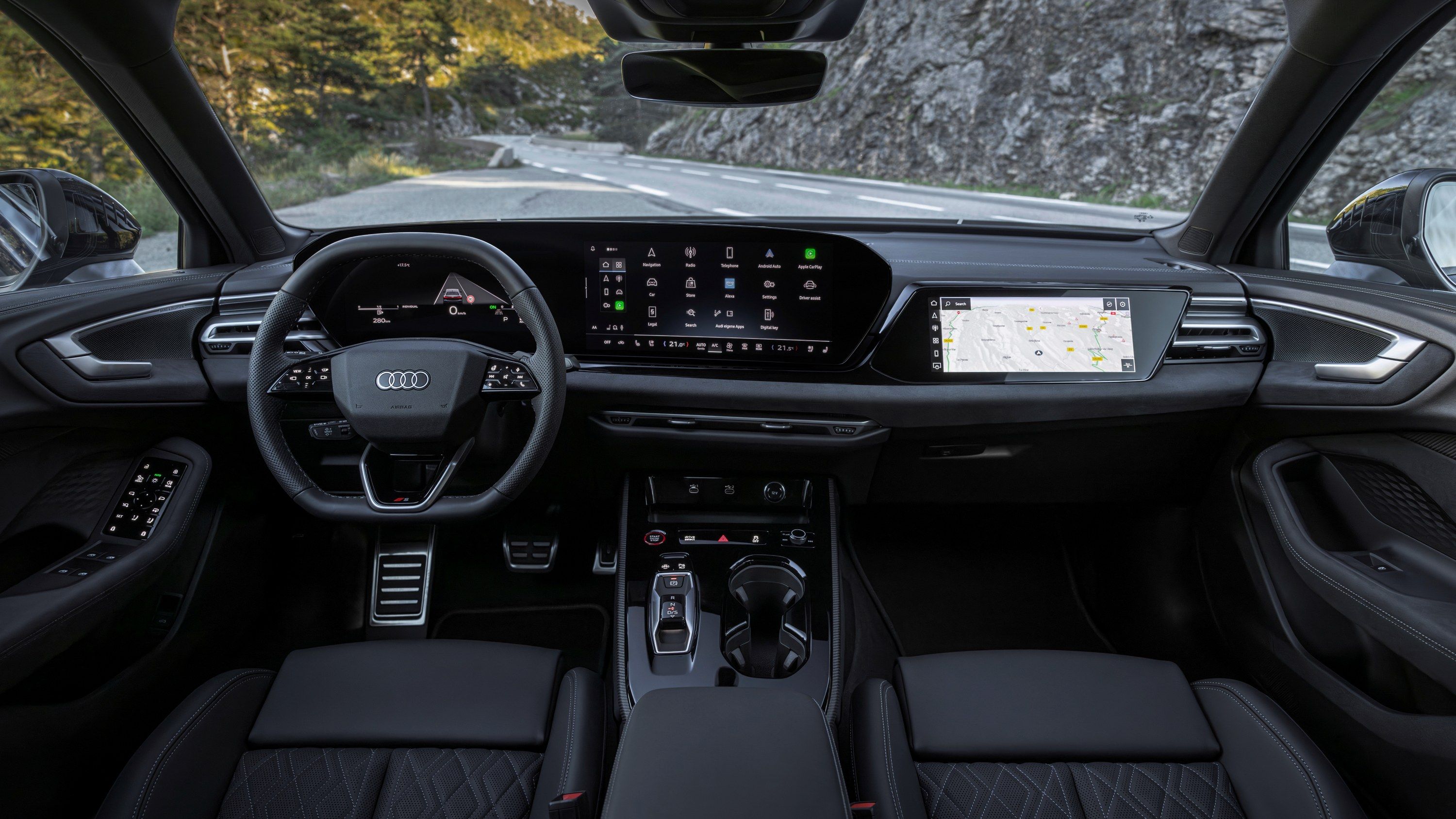
No new premium car can launch without the latest technology and a plethora of screens, including one for the front passenger. Audi pulls off the latter better than most, with a 10.9-inch screen that integrates neatly into the design of the dash and can be switched off entirely or made to display a decorative pattern to avoid looking like an eyesore. The core screens are angled towards the driver – Audi emphasized the S5 being driver-focused this time around – comprising an 11.9-inch instrumentation screen supported by the main infotainment’s 14.5-inch touchscreen.
The latest version of Audi’s Multi Media Interface (MMI) has native app functionality so you can download Spotify, YouTube, and even games. My brief sojourn in Nice afforded me some time to play with these systems as both driver and co-pilot, revealing some pleasant points, but also a few areas of concern. The MMI system’s UI is relatively intuitive and responds quickly to touch inputs, including pinch and swipe gestures. It also uses ChatGPT and voice commands to let you control infotainment and climate settings, but it didn’t like casual language and only responded when I used more rigid descriptive commands: “Hey Audi, set the driver’s climate control to 84 degrees,” instead of “Hey Audi, turn the temperature up.” Herein lies another flaw: just give me physical buttons to control the climate. On more than one occasion, I had to take my eyes off the road to find a basic function on the 14.5-inch screen. It was both infuriating and dangerous.
The passenger screen let me down somewhat, as it largely mirrors the primary MMI screen, but with limited functionality. You can pull up a display to control the massage seats; this screen shows the driver’s seat as well as the passenger’s, but do you think I could set a massage routine for the driver? No. Likewise, I could connect my Android device via Bluetooth (wireless Android Auto and Apple CarPlay come standard) to the car, but there was no dedicated Android Auto display for the passenger screen through which I could use various apps. If the passenger screen is going to merely give me a watered-down version of the main screen’s functions, then what’s the point?
The only element I did like was that when I opened up a YouTube video from the passenger side, my driving partner was unable to watch it; the screen appeared blank to her when a video was playing, although when navigating menus, she could clearly see everything I was doing. The Bang & Olufsen Premium Sound System was also notable, now featuring speakers in the headrest through which phone calls and navigation commands are played; it was initially disconcerting, but it quickly made sure I never missed a command when driving around a country unfamiliar to me.
Performance: Punchy V6 Meets Dual-Clutch Swiftness
|
2025 Audi S5 Performance Specs At A Glance |
|
|---|---|
|
Engine |
3.0-liter twin-turbo V6 (EA839evo) |
|
Transmission |
7-speed dual-clutch automatic |
|
Drivetrain |
Quattro all-wheel drive |
|
Displacement |
2,995 cc |
|
Power |
362 hp @ 5,500-6,300 rpm |
|
Torque |
406 lb-ft @ 1,700-4,000 rpm |
|
0-60 MPH |
|
|
Top Speed |
155 mph |
|
*European-spec S5. American specs may differ slightly. |
|
Under the hood of the S5, there’s evolution, not revolution. Instead of giving the newcomer a detuned version of the Porsche-derived 2.9-liter twin-turbo V6 from the RS5, Audi’s stuck with the 3.0-liter V6 from the old car with a few updates. These include variable turbine geometry (VTG) for the turbocharger, a switch to the Miller combustion cycle, and, in Europe at least, a 48-volt mild hybrid system. The US doesn’t get the latter, though, with Audi officials citing two key reasons for this:
- American buyers won’t be comfortable with the engine switching off at highway speeds as the MHEV engages a ‘coasting’ function
- The stop/start system and switchover between electric propulsion and combustion drive at low speeds are too jerky
While I feel we can’t mollycoddle buyers and hide progress for fear of change, the second point is entirely valid. On more than one occasion during my several hours driving the S5, the start/stop system jerked to life a little too harshly, and the system didn’t like when you slowed behind traffic to almost a halt only to accelerate into a slip-lane; this resulted in the drivetrain bucking uncomfortably.
To work around this, the American-spec S5 will lose a little on the gas mileage front and rely on a more traditional start/stop system that behaves smoother. While we’ll have to wait to drive a US-spec model to confirm how big the improvement is, what won’t change is the seven-speed DCT we sampled. I find it curious Audi didn’t use the 8-speed ZF automatic here as it does in almost every other longitudinal-platform model, with Audi engineers telling me at the event that with the VTG and revised fuel mapping, the DCT was better suited to managing the torque the motor produces. Just how much of the jerkiness I experienced at low speeds was down to the gearbox and how much was a result of the MHEV system remains to be seen.
What was apparent was that the engine still relies heavily on boost, and under high throttle applications, you can hear the turbos spool for what feels like an age before the transmission suddenly kicks down and bumps you in the kidneys with a sudden thrust forward. Even in sportier driving modes – and with the gearbox hanging onto a lower ratio in S mode – there’s a disparity between throttle inputs and the engine’s response. This is where I feel the ZF torque converter automatic might have made things better, bringing in the torque hit in a smoother fashion than the S5 currently delivers.
Driving Impressions: More Communicative, But Still A GT At Heart
In my 13 years of listening to automakers wax lyrical about the updates made to a car from one generation to the next, I’ve seldom heard Audi emphasize a connection to the driver as being a priority. But this time around, that was a key point. The biggest change in this regard is the steering; it’s still an electronically power-assisted steering (EPAS) setup, but it now features rigid mounts on the steering rack which removes much of the vagueness and even transmits a fair amount of road texture to the driver through the wheel. It’s a variable geometry rack, so the more lock you wind on, the tighter it turns, and around the tight hairpins of southern France, the sizable Sportback did a remarkable job of making some tight turns. But despite this nimbleness, the car tends to feel big. The high shoulder line (even when lifting the seats higher than I traditionally like to) created a blind spot on the front passenger side that made tight right-hand turns trickier to navigate than I’d have liked.
It’s not just the steering that’s been stiffened, though. Stiffer axle bearings have been applied, and at the rear axle, stiffer bushings and anti-roll bars are present. When asked if they had to soften other components like the dampers to compensate, Audi’s suspension engineers said the suspension geometry was recalibrated in such a way that they didn’t need to overcorrect with softer dampers. This could easily have resulted in a harsher, more jarring ride, but it doesn’t. Instead, there’s a little less lean, a little more control of the body when scything through twisting roads, and more feedback as to what the chassis is doing beneath you.
When you hit a bump, there’s no wincing, even on 20-inch wheels with low-profile rubber. Expansion joints are dealt with swiftly and there’s a suppleness to the way the S5 rides. You hear the road more than you feel it, with a fair amount of tire noise from the rear of the car on rough road surfaces but none of the accompanying jitteriness through the body itself.
Audi’s Days Of Understeer Are Over
So Audi’s got the sense of connection right; this is one of the most communicative mainstream Audi models I’ve driven in years. But how does it actually handle? In a word: solidly. The steering is one thing, but greater negative camber dialed into the suspension provides better grip levels and a more progressive ramp-up to the limits of adhesion. Audi also combines brake-based torque-vectoring with a torque-vectoring rear differential, the combination of which was almost imperceptible in the way it behaved. But what was noticeable was the sharpness with which the front of the S5 turned into corners and the immediacy with which it responded to inputs.
This is a big car, and it never once felt smaller than its 190 inches, but it still behaved remarkably competently through the twisty stuff. Audis have been perennially slated for their tendency to understeer under duress, even at seven-tenths, but there’s greater neutrality now than before. This isn’t a car that likes to hustle at ten-tenths – it still feels too large and ungainly for that – but up to 80- or 90%, it’s quite happy to get down and boogie much better than S-badged Audis of the past. An RS version is incoming, and if the S5 is the platform from which Audi launches the new RS model, it ought to be good.
Conclusion: Less Sedan, More GT – A Winning Combination
In science, the theory of convergent evolution is when multiple species independently evolve towards similar features, like sharks and dolphins having a similar body shape despite having different evolutionary roots. With the new S5, convergent evolution has found its way to the humble three-box sedan, making it more stylish and practical as it strives to survive the SUV revolution.
The packaging is on point, it looks as good as an S5 should, and there’s a distinct improvement in how the S5 drives. It’s sharper and more communicative than before, but with a hint of restraint that paints it as more of a grand tourer than a true sports sedan. It’s a big plush brute that can crush miles in comfort, whether behind the wheel or in the passenger seat, but one that will be equally at home on the school run.
This is a thoroughly impressive package, but I still have hang-ups about the engine/gearbox combination that will have to wait for the US-spec to arrive sans the MHEV system before we can cast a final verdict. But as far as initial impressions go, the 2025 S5 provides would-be AMG C43 buyers with an alternative that looks, drives, and does life better.
Of course, price may play into the decision for many buyers, and that’s the one detail Audi can’t confirm just yet. The S5 – and the standard A5 Quattro – arrive in the second half of 2025, with pricing to be confirmed closer to the time. But Audi representatives told DrivingOnRoad they’re aiming for similar pricing to the outgoing model’s $57,900 base MSRP.